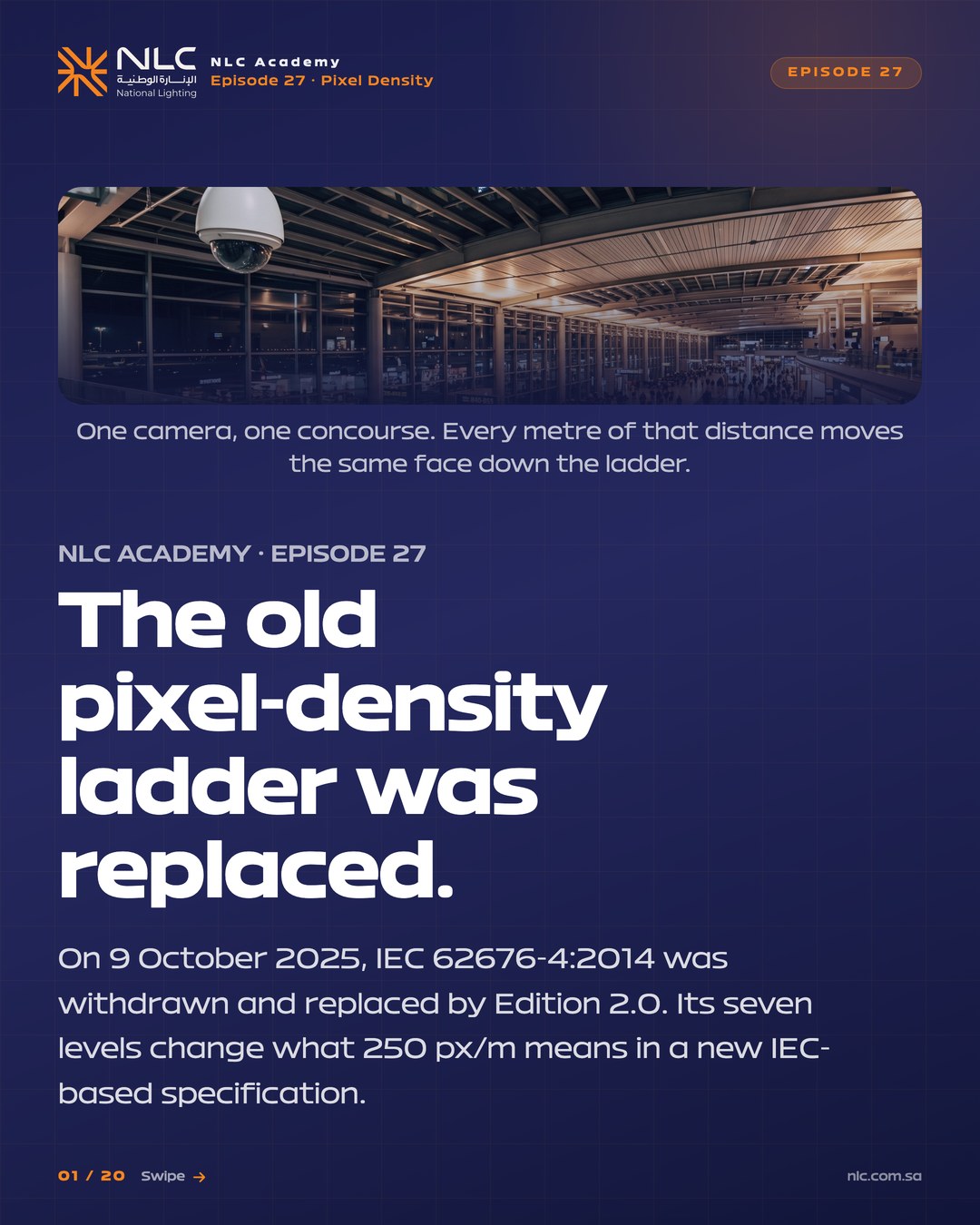
IEC 62676-4:2014 was withdrawn on 9 October 2025 and replaced by Edition 2.0, which turns the six-level ladder the industry still calls DORI into seven levels. 250 px/m, the old Identify figure, is now Characterize; high-certainty identification (Scrutinize) needs 1500 px/m. If your specification still cites the 2014 edition, it cites a withdrawn document.
Animated explainer, press play to watch the concepts now; the filmed cut publishes once production wraps.
Key Takeaways
What you'll walk away with
Four ideas to carry into the next specification conversation you have.
01
Seven levels now, and DORI is not one of them.
IEC 62676-4 Edition 2.0 (2025): Overview 20, Outline 40, Discern 80, Perceive 125, Characterize 250, Validate 500, Scrutinize 1500 px/m. The 2014 standard never contained the word DORI or the unit px/m in the first place; both are industry shorthand.
02
PPM = sensor pixels / scene width.
It is, and substituting the lens gives the form that ends the megapixel argument: px/m = f / (d × pixel pitch). The pixel count cancels out. Two 8 MP cameras on the same 4 mm lens differ by 38% in pixel density, because one has 1.45 µm pixels and the other 2.0 µm.
03
Wide angle ≠ better coverage.
True, and there is a ten-second test for whether your own trigonometry is even valid on that lens: divide tan(H/2) by tan(V/2). On a 16:9 sensor a rectilinear lens gives 1.78. A 93°/50° dome gives 2.26, because it is barrel distorted, and its published range is 33% further than the formula predicts. Use the manufacturer's table for wide lenses.
04
Blur is the multiplier nobody applies.
And there is a bigger multiplier nobody applies: blur = speed × exposure × density. Pixel density multiplies the smear, so raising it does not sharpen a moving face. At 250 px/m a walking person at 1/30 s smears 11.7 pixels across a face that is only 40 pixels wide.
START WITH THE DATE
The 2014 edition the industry still cites has been withdrawn
250 px/m is now Characterize: person type, gait, action; vehicle brand (cl. 3.1.6).
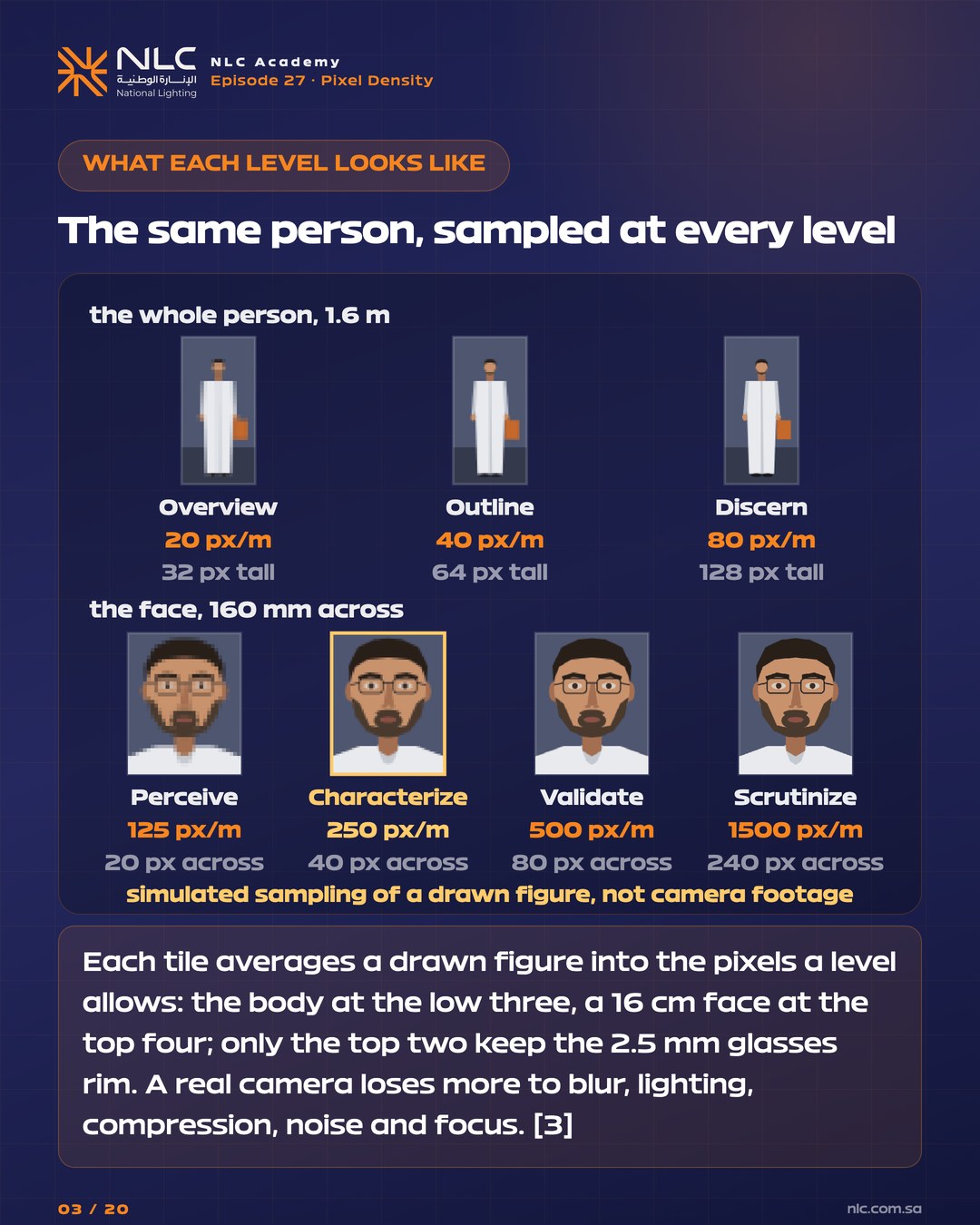
WHAT EACH LEVEL LOOKS LIKE
The same person, sampled at every level
Each tile averages a drawn figure into the pixels a level allows: the body at the low three, a 16 cm face at the top four; only the top two keep the 2.5 mm glasses rim. A real camera loses more to blur, lighting, compression, noise and focus.
WHERE 250 PX/M COMES FROM
The 250 px/m rule traces back to PAL-era screen-height criteria and the Kell factor
PAL had 576 lines; the 2014 standard treats them as about 400 usable (the Kell factor) and sets Identify at 100% of screen height, or 4 mm per pixel: 1 m ÷ 4 mm = 250 px/m. For a 1.6 m person on 400 lines, 400 × 4 mm = 1.6 m.
THE EQUATION THAT ENDS THE MEGAPIXEL ARGUMENT
Megapixel count alone does not determine pixel density
px/m = Nh / scene width = Nh / (2d · tan(HFOV/2)), and for a rectilinear lens px/m = f / (d × pitch). Same megapixels, different density: at a given distance, focal length and pixel pitch set px/m; the pixel count sets the field of view.
Reference
Pixel density levels × use case
Per IEC 62676-4 Edition 2.0 (2025), on the standard 1.6 m target. Ranges are computed for one 8 MP camera at 90° HFOV, centre of frame.
Level
Min PPM · subject height in px
Use case
Overview
20 px/m · 32 px
Presence and count only. One 8 MP camera at 90° reaches 96 m
Outline
40 px/m · 64 px
Body shape and direction of travel. Reaches 48 m
Discern
80 px/m · 128 px
Tell one person from another in the scene. Reaches 24 m
Perceive
125 px/m · 200 px
Clothing, carried objects, activity. Reaches 15 m
Characterize
250 px/m · 400 px
Person type, gait, vehicle brand. This is what the old ladder called Identify. Reaches 7.7 m
Validate
500 px/m · 800 px
Confirm a known identity. Reaches 3.8 m
Scrutinize
1500 px/m · 2400 px
Establish who someone is, with high certainty. Reaches 1.3 m
THE PIXEL THAT WINS ON DENSITY LOSES ON LIGHT
Smaller pixels, less light
Same lens, f-number and exposure: a 2.0 µm pixel has 1.9× the area of a 1.45 µm pixel, so 1.9× the photons. Shot-noise SNR grows with the square root, so the 2.00 µm pixel gives about 38% higher shot-noise-limited SNR, while the 1.45 µm sensor gives 38% more density.
ONE CAMERA IS NEVER ONE LEVEL
Draw the bands, not a range
Density falls as 1/distance, so on log axes one camera is a straight line crossing each level at a fixed distance ratio. 3840 px, 90° rectilinear lens, centre of frame: Overview 96 m, Discern 24 m, Characterize 7.7 m, Scrutinize 1.3 m.
MOTION BLUR SCALES WITH DENSITY
Higher density makes the same motion span more pixels
blur (px) = speed × exposure × density. For a subject crossing the frame at 250 px/m, a 1.4 m/s walk at 1/30 s smears 11.7 px across a 40 px face: 29% of its width.
THE DRIVER DECIDES THE SHUTTER
A fast shutter needs a low-flicker driver
Saudi mains run at 60 Hz. In an ideal sinusoidal model of lighting with mains-related 120 Hz ripple, rolling-shutter exposures of whole cycles (1/120 s, 1/60 s) cancel banding; 1/100 s keeps 16%; the 1/350 s that freezes a walk keeps 82%.
SAUDI ARABIA REGULATES THE GEOMETRY
An identification camera 40° off-axis fails the Saudi geometry requirement
This is aiming geometry, not resolution. MOI identification: within 30° right or left of straight-on and 15° above or below the horizon line.
Deep Dive
Beyond the megapixel race
Five facts the camera salesperson didn't mention.
A 4K camera at the wrong angle is useless.
Correct, and Saudi Arabia has legislated the point: the MOI conditions document does not tell you to buy 4K cameras, it names the field-of-view class each camera position must achieve and then limits the aiming. Identification cameras within 30° right or left of straight-on and 15° above or below the horizon line, with WDR of at least 110 dB; strong identification (the document's Inspection class, التفتيش) 10° both ways with the image centre between the eyes; plate cameras 30° (Ed. 1 v1.1, pp. 20 to 22). The 15° line alone keeps a camera mounted at 3.5 m at least 7.1 m from the face. Article 12 of the camera law fines per camera: SAR 500 for equipment that misses the document's technical specifications (12a) and SAR 1,000 for a camera not installed as the document sets (12b); a review committee decides which applies (Article 11). The IEC text only says cameras should be mounted around head height.
Storage scales with bitrate, not megapixels.
Size it from the rule the Saudi document actually writes: 1080p minimum, and for motion-linked recording at least 70% of the day at 10 fps, retention not less than 31 days. At 4 Mbps that is 0.94 TB per camera before the capacity clause. Item 10 (p. 13) then asks for “an additional 20% of the total capacity of the recording system”. The 20% is of the total, so the recording may fill 80% of it: need ÷ 0.8, 1.17 TB. That also covers the narrower reading of adding 20% to the need (1.12 TB), so it is the safe design value; if the authority on a project reads it differently, get that in writing. Read the sector tables too: oil and petrochemical sites, power and desalination, public transport stations, and category 4 and 5 hotels and conference venues require 91 days at 15 fps (pp. 38, 40, 45, 75). ATM cameras get 91 days in the shopping-mall table (p. 48), while the banks table (p. 50) prints 19 days and 51 fps for “MTA” cameras, which reads as a transposed 91, 15 and ATM: confirm with the ministry. At 91 days the same arithmetic gives 3.44 TB per camera. These are illustrative estimates at exactly 70% duty: ≥70% is a floor, so a camera that records more needs more, and continuous recording needs about 1.67 TB for 31 days and 4.91 TB for 91. TB here is decimal (1012 bytes), before file-system, RAID and recorder overhead.
A fast shutter needs a low-flicker driver.
Saudi Arabia's grid runs at 60 Hz (Grid Code 2.4.2.1), so mains-driven light ripples at 120 Hz. In an ideal sinusoidal model, a rolling shutter exposure that holds whole cycles, 1/120 s or its multiples, cancels banding; PWM dimming, mains drift between 59.9 and 60.1 Hz and camera timing can leave some even then. The European 1/100 s keeps 16% of the ripple as banding. But the shutter that freezes a walk at Characterize density is about 1/350 s, and that keeps 82%. So the banding in the frame is the driver's modulation times a share the shutter sets: an unfiltered driver bands at 82%, a driver inside IEEE 1789's no-effect line at 120 Hz (Mod% 4.0) at 3.3%. IEEE 1789 rates risk to people, not camera compatibility, so that 3.3% is a model result, not a CCTV threshold; test banding on site with the real driver and camera. Sensor makers say the same from the other side: below one light period, flicker from AC-driven lamps cannot be avoided. Write the driver's Mod% into the lighting specification, because IEEE 1789 itself has been inactive since March 2026.
Pixel density is the fallback in Saudi Arabia, not the primary method.
Each Saudi class is defined first as the target's image size as a share of the view on the display, on a 1.6 m standard target: Identification not less than 120%, Recognition 50%, Observation 25%, Detection 10%, Monitoring 5%. Pixel density may be substituted only in exceptional cases and with prior Ministry approval, so a px/m-only specification is a non-compliant one. The percentages match IEC 62676-4:2014 Table 3, though not one column: 120% is its NTSC value, where PAL gave 100%, while 50% and 25% are the PAL values. The px/m substitutes (1000, 250, 125, 62, 25 and 12.5 from strong identification down to monitoring) are the 2014 values, except that Observation is printed as 62, and plate reading adds a seventh rung at 400 px/m (Ed. 1 v1.1, pp. 20 to 22). Signage is not a PDPL requirement either: it comes from the camera law, and PDPL then governs what happens to the data afterwards.
A Saudi CCTV system can fail compliance on its lighting.
The conditions document carries a mandatory section titled Security Lighting: the camera field of view fully lit with no dark areas, and, at external sites, infrared allowed in secondary areas or wherever visible light is not enough (p. 25), never reflecting into the camera, and no harm to the safety of others, such as drivers' vision. It gives no lux, ratio, colour or flicker figure, so the designer brings the numbers. IEC 62676-4 asks for a max-to-min ratio ideally 10:1 or better, light directed along the expected direction of travel so faces are lit, and luminaires preferably above the camera and at least 2 m from it, because they attract insects. The UK Home Office's 2009 manual recommends no more than 3:1. On 6 m poles of an idealised luminaire, that is the difference between 31 m and 18 m spacing. On WDR itself, note the trade: turning it on typically halves the frame rate and doubles the exposure window, which blurs the face you bought it to see.
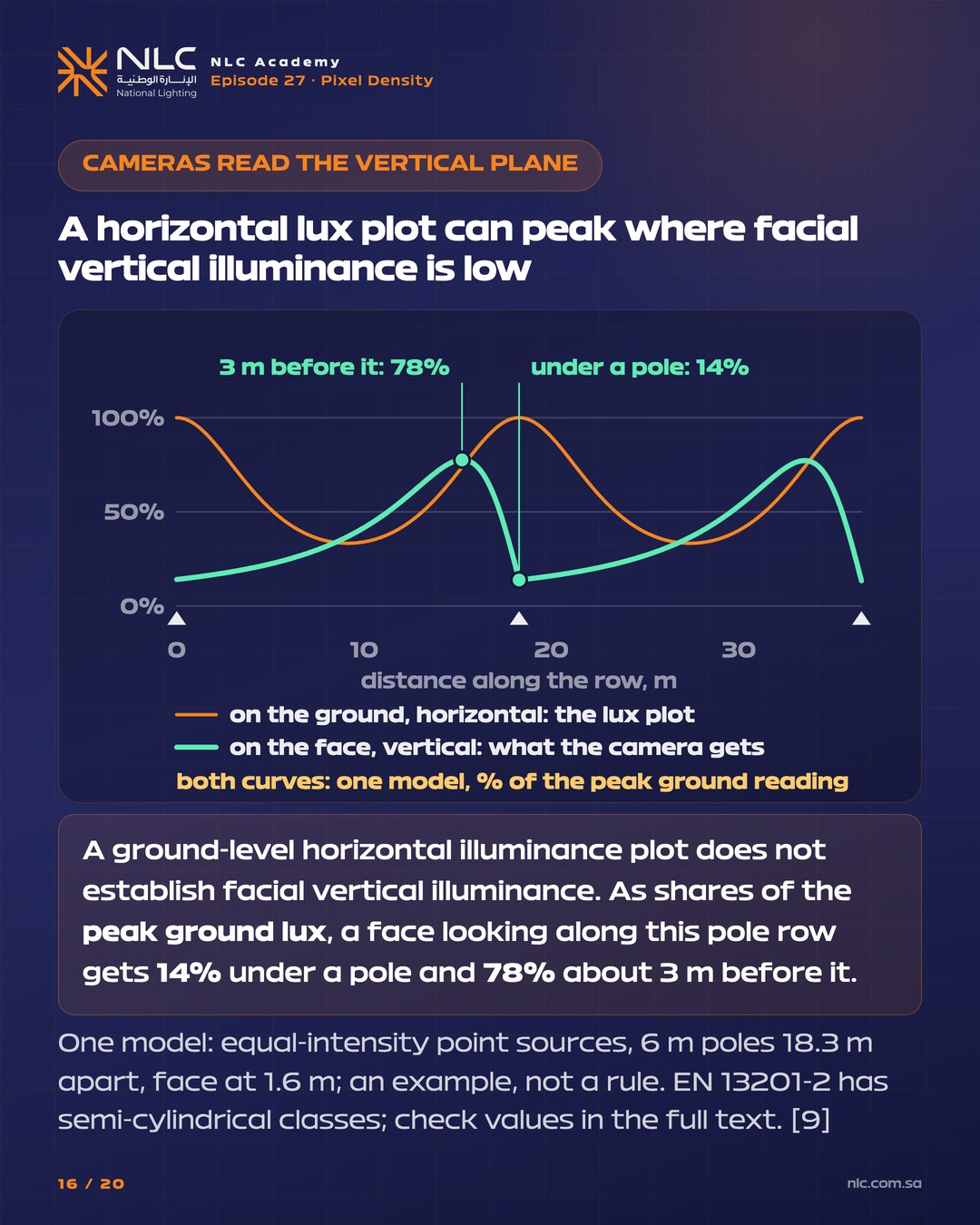
Cameras read the vertical plane.
Lighting calculations report horizontal illuminance on the ground. A camera needs vertical light on the face, from its own side. Along a row of poles the lux plot peaks directly under each pole, which is exactly where a face looking along the row gets 14% of that reading; about 3 m before the pole it gets 78%. So a ground-level horizontal illuminance plot does not establish facial vertical illuminance. Road lighting addresses faces through the semi-cylindrical classes of EN 13201-2, written for the human eye; we have not reviewed that standard in full, so read its class values there before citing them. No CCTV document reviewed here sets a facial vertical illuminance, which is why a specification has to name one and have it measured.
Identify has a number. Its test is a person.
In the withdrawn 2014 edition, clause 6.7 gives every level a design figure, Identify included: 100% of screen height on PAL, 120% on NTSC, or 4 mm per pixel, which is 250 px/m. The acceptance test in clause 13.3.2 gives millimetres for inspect, recognise, observe, detect and monitor, and for identification sends you to Annex B: nine printed faces, a height stick and an operator, at a screen height the Operational Requirement sets. The annex passes at 4 out of 6, reached by naming one face and getting only the broad category right on the other, while the number-plate test beside it needs every character. The 2025 edition's contents list a normative Annex B test protocol, but we could not access its procedure or scoring, so the contract should state the acceptance method and pass criteria itself. On Saudi projects the MOI document adds its own image acceptance (p. 27): a clear, stable image in moderate wind, obstructions under 5% of the frame and none at its centre. Pixel density is a design input, not a guarantee, and the IEC levels assume a human viewer; face or plate analytics follow the vendor's own requirements.
THE CLAUSE THAT REORDERS EVERY SAUDI SPEC
Pixel density is an alternative criterion, not the primary method
MOI wording: target image size not less than a share of the display view, on a 1.6 m standard target: Identification 120%, Recognition 50%, Observation 25%, Detection 10%, Monitoring 5%. With prior Ministry approval, exceptionally, 250 px/m for Identification.
WORK IT BACKWARDS
From mounting height to focal length
3.5 m mount, 1.6 m target point, 15° limit: 7.1 m on plan, 7.3 m slant. 8 MP, 2.0 µm pixels (7.68 × 4.32 mm active): f = px/m × d × pitch gives ≈3.7 mm for Characterize and ≈22 mm for Scrutinize.
IDENTIFY: A DESIGN FIGURE AND A HUMAN TEST
The design figure exists. The test is a person.
In the withdrawn 2014 edition, cl. 6.7 gives Identify 100% of screen height or 4 mm per pixel; its acceptance test (cl.
READ THE SECTOR TABLE
31 days, 91 days, and the storage they need
Baseline: 31 days, motion-linked recording ≥70% of the day at ≥10 fps (p. 13).
THE LIGHTING CLAUSE IN THE SAUDI DOCUMENT
A Saudi CCTV system can fail on its lighting
MOI's mandatory Security Lighting section: field of view fully lit, no dark areas; at external sites, infrared may be used in secondary areas or where visible light is insufficient, never reflecting into the camera; no harm to others, such as drivers' vision. No lux, ratio or colour figure.
CAMERAS READ THE VERTICAL PLANE
A horizontal lux plot can peak where facial vertical illuminance is low
A ground-level horizontal illuminance plot does not establish facial vertical illuminance. As shares of the peak ground lux, a face looking along this pole row gets 14% under a pole and 78% about 3 m before it.
From the Academy to the Field
NLC lighting, designed to the clause your CCTV system is judged on.
NLC does not sell cameras. It sells the thing that makes them work: illuminance in the field of view that meets the conditions document's Security Lighting clause, a max-to-min ratio at or better than the 10:1 IEC 62676-4 recommends, vertical light on faces from the side the cameras look from, and drivers quiet enough at 120 Hz for a shutter fast enough to freeze a walk, without harming drivers' vision on the road beside it.
Practical lighting know-how from NLC Academy. No spam, unsubscribe anytime.
By subscribing you agree to receive NLC emails.
Sources
Sources & further reading
The standards and regulations behind every number on this page.
IEC 62676-4 Edition 2.0 (2025), the current standard, published 9 October 2025. Seven levels at 20, 40, 80, 125, 250, 500 and 1500 px/m, which its foreword calls O2DCPVS; 250 px/m is Characterise (cl. 3.1.6). Read from the publisher's sample pages; the full text, including the Annex B test protocol, was not reviewed. iec.ch
IEC 62676-4:2014 (withdrawn 2025-10-09), the document the industry still quotes. Clause 6.7 states each level as % of screen height or mm per pixel (Identify 4 mm); clause 13.3.2 tests identification with the Annex B face panel instead. In Europe, EN 62676-4:2015 may remain until 30 November 2028. iec.ch
Axis white papers on pixel density per IEC 62676-4 (2026), Pixel density based on IEC 62676-4:2025 (September 2026): the source of the 16 cm face model (40 px per face at 250 px/m). It paraphrases Characterize as vehicle type and category; the standard's own definition (cl. 3.1.6) says vehicle brand, which is what this page uses. axis.com (PDF)
Saudi MOI security camera conditions document, Edition 1, v1.1. Recording devices pp. 12 to 13 (31-day baseline, 70% of the day at 10 fps, item 10: 20% of total capacity, ONVIF 2.0 item 16); classes, angles and px/m substitutes pp. 20 to 22; Security Lighting p. 25; image acceptance p. 27; 91-day sector tables pp. 38, 40, 45 and 75; ATMs 91 days in the malls table (p. 48), while the banks table (p. 50) prints 19 days and 51 fps. No issue date is printed; the PDF metadata says 1 November 2025. The ministry's direct PDF link now redirects to its home page, so this links the copy archived on 10 December 2025. web.archive.org (MOI PDF)
Saudi camera law, Royal Decree M/34, Article 12 fines per camera: SAR 500 for equipment that misses the conditions document's technical specifications (12a) and SAR 1,000 for a camera not installed as the document sets (12b); Article 11 committees decide which applies. Signage comes from this law, not from PDPL. laws.boe.gov.sa
UK Home Office CCTV Operational Requirements Manual 28/09 (2009, archived), section 4.2.2 recommends no more than 3:1 between minimum and maximum illumination in an artificially lit scene. The manual is withdrawn and has no current official URL; it was checked from an archived copy, and this links the Home Office collection that replaced it. gov.uk
EN 13201-2:2015 Road lighting, performance requirements, cited for its semi-cylindrical (SC) and vertical-plane (EV) illuminance classes, written to help people see faces on roads. We have not reviewed the full standard, so this page states no class values; read them in the standard. bsigroup.com
IEEE 1789-2015; SERA Saudi Arabian Grid Code; onsemi MT9V115, the no-effect flicker line (Mod% 4.0 at 120 Hz; IEEE lists 1789-2015 as Inactive-Reserved since 26 March 2026 on the IEEE SA site), the 60 Hz nominal frequency held within 59.9 to 60.1 Hz (Grid Code, May 2024, cl. 2.4.2.1), and a sensor maker's statement that exposures shorter than one light period cannot avoid flicker. sera.gov.sa (Grid Code PDF)
Sony IMX415 and IMX678 product flyers, 1.45 µm and 2.0 µm pixels on Type 1/2.8 (6.43 mm diagonal) and Type 1/1.8 (8.86 mm) sensors, both recording 3840 × 2160. The IMX678 flyer is on the same Sony site. sony-semicon.com (IMX415 PDF)
ONVIF conformance process and Conformant Products database; Profile S v1.3, Profile T v1.0, ONVIF calls conformance a self-declaration scheme, so do not rely on an "ONVIF Certified" label: check the model, firmware version and profile in the database. The MOI document asks recorders to be compatible with "ONVIF 2.0" (p. 13, item 16), which is not an ONVIF profile name, so name the profile. Profile S devices must stream MJPEG with H.264 conditional; Profile T devices need one of H.264 or H.265, and clients must decode both. onvif.org
Shareable
Forward the carousel to a colleague
A 20-slide explainer, ready to post straight to LinkedIn as an image carousel.