Episode 14 ~1:40 Materials EN · العربية

Painting and light, why the same fixture reads differently on every wall

The same downlight casts very different light onto a matte grey wall vs a satin white one. LRV (Light Reflectance Value) is the spec line designers miss, and the one that makes the most difference at handover.

Animated explainer, press play to watch the concepts now; the filmed cut publishes once production wraps.

What you'll walk away with

Four ideas to carry into the next specification conversation you have.

01

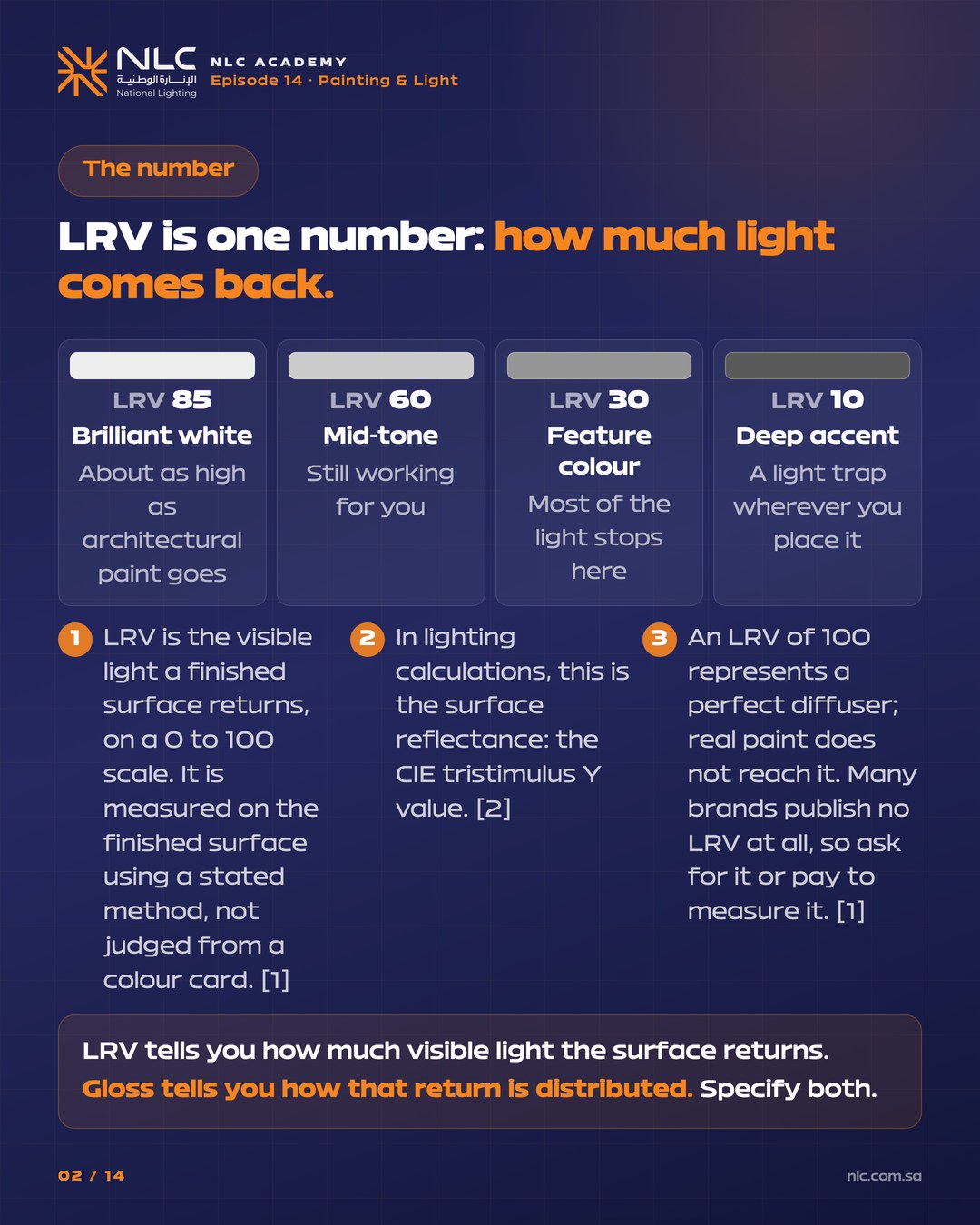
LRV is reflectance, 0 to 100.

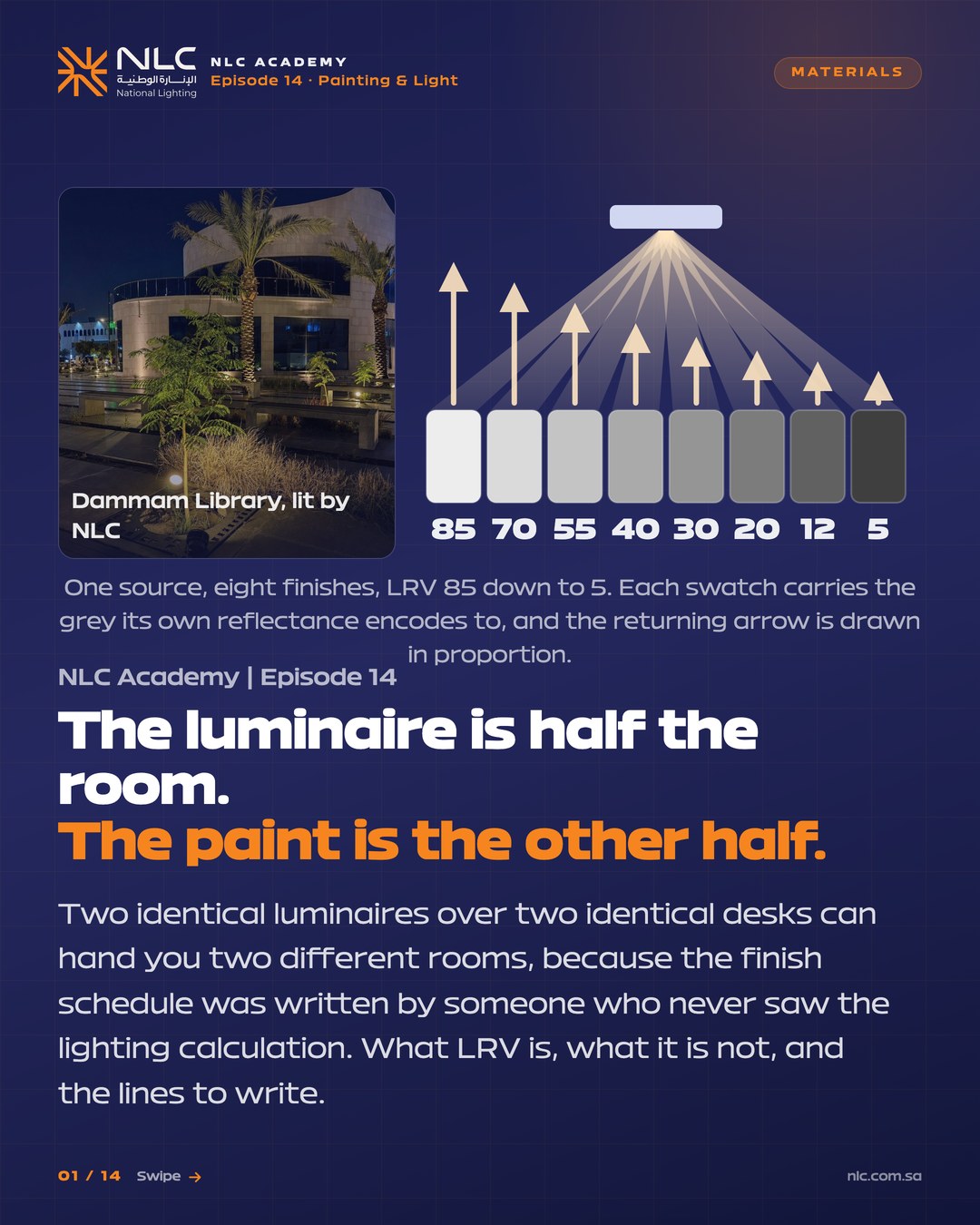
LRV 80 reflects about 80% of the visible light that lands on it, LRV 5 about 5%. It is measured to a published method (BS 8493), not judged from a colour card. The 30-point LRV rule you may have met is accessibility guidance on visual contrast between surfaces, not a rule about interreflection.

02

Matte scatters, gloss reflects.

Matt scatters close to a diffuse lobe and gives an even ambient. Gloss returns the same energy into a narrow specular lobe, so you see the luminaire in the wall. LRV tells you how much visible light the surface returns; gloss tells you how that return is distributed. Specify both: gloss units at a stated angle per ISO 2813, alongside the LRV.

03

Light walls lower the load, not the target.

The maintained illuminance a task needs is set by the task, so paint never lowers the requirement. Bright walls can reduce the installed power required to achieve the same target illuminance, by raising the utilisation factor. Dark accent walls buy their look with watts.

04

Specify LRV on the colour schedule.

Write 'wall: LRV ≥ 70' alongside the paint code. Without it, the contractor is free to substitute and your DIALux model breaks.

Paint changes the lux

◆ The wall is part of the fixture
Light reflectance value and room brightness
LRV 80White1.4×brightnessLRV 50Grey1.0×brightnessLRV 30Dark grey0.7×brightnessLRV 15Charcoal0.5×brightness
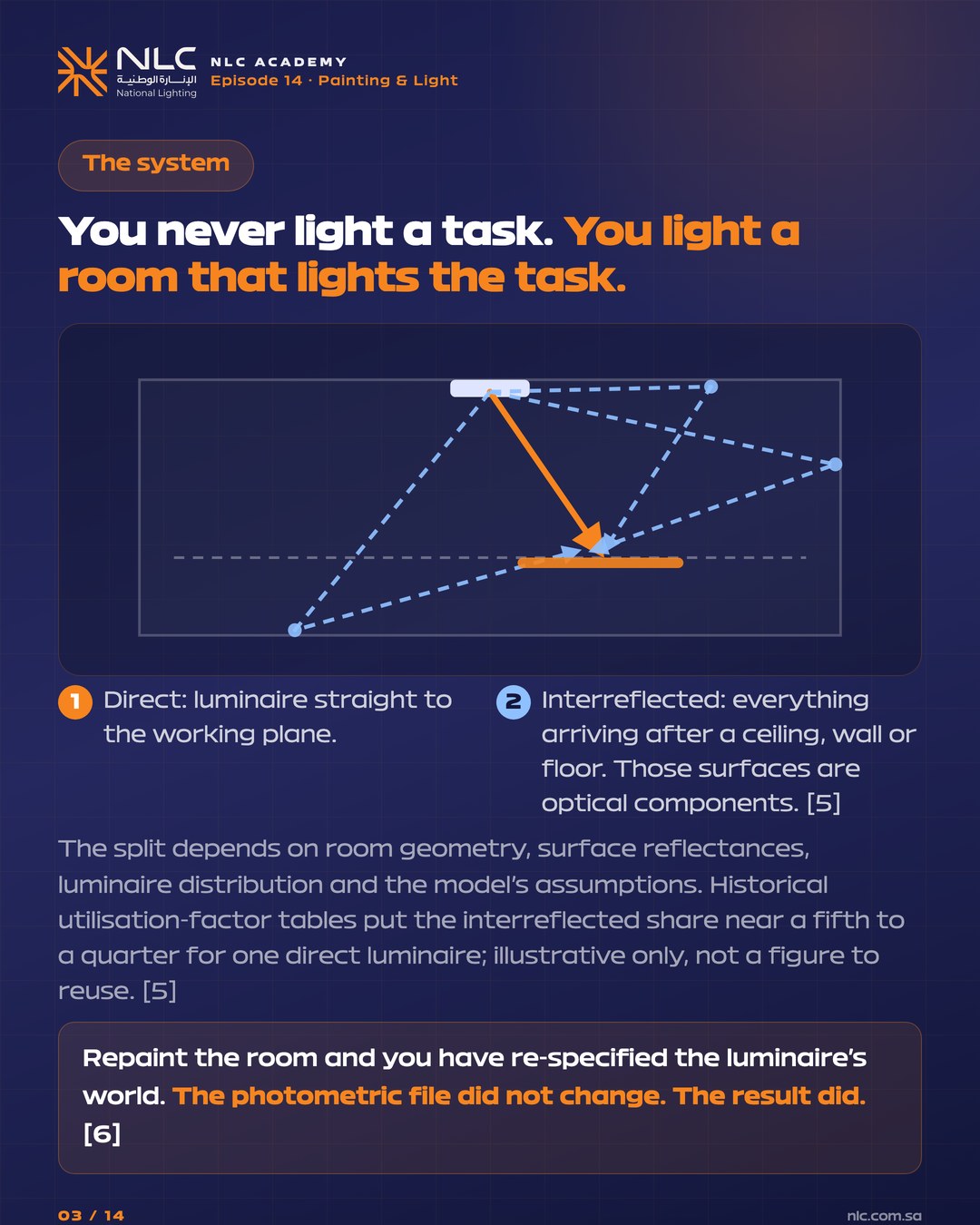
A large share of the light in a room arrives only after bouncing off the walls and ceiling. Swap LRV 80 walls for LRV 15 and the same fixtures deliver a visibly different room; how much is an output of the calculation for that room, not a fixed percentage. The finish schedule is a lighting decision.
◆ The room is a reflector
Bright walls recycle light; dark walls eat it
White walls · light multipliesCharcoal · light absorbed
Light bounces. Pale walls send it back into the room again and again, lifting the ambient level for free; dark walls swallow it on the first hit. The finish schedule is part of the lighting design.

Surface × LRV × impact on lux

Indicative Light Reflectance Value bands for common interior finishes. Bands vary by product, batch, substrate and number of coats, so specify a measured value on the delivered product rather than a value from this table.

Finish LRV Against the standard’s ranges
White matt paint80-85Top of the ceiling range, top of the wall range
Off-white matt70-75Inside the ceiling range, inside the wall range
Cream / beige matt55-65Inside the wall range, below the ceiling range
Light grey matt40-50At or below the bottom of the wall range
Medium grey matt25-35Below the wall range; a deliberate choice to justify
Dark grey / charcoal10-15Well below every wall and ceiling range
Walnut wood veneer10-20Well below the wall range; verify the actual veneer
Polished marble (light)60-70 (gloss)Reflectance is only half the story: check reflected glare

How finish schedules become lighting decisions

Five points the finishes consultant and the lighting consultant should agree on early.

Direct light is only part of the room.

A significant share of the light reaching a desk has already struck a ceiling, a wall or the floor. Lower the ceiling and wall reflectances and the same luminaires deliver less on the task. The size of that loss is an output of the calculation for that room, that distribution and those surfaces, not a constant, so run it rather than quote a percentage.

Sheen affects glare more than lux.

A gloss white and a matt white can carry a similar LRV and still behave completely differently, because gloss returns the light into a narrow specular lobe: where angle in equals angle out, the observer sees the luminaire itself in the wall. That is reflected glare and veiling reflections, which are treated separately from luminaire glare; UGR (CIE 117) rates discomfort from the luminaires in the field of view and its tabular method does not model specular reflection off room surfaces. Specify matt or eggshell on large vertical surfaces, especially near screens, and keep gloss for trim.

Carpet usually loses lux.

Carpet commonly reads far darker than the sample looked, and floors sit at the bottom of the recommended reflectance range to begin with. Where light on faces matters, a lighter floor finish is a design lever, not a decorator’s choice. Treat any LRV band you have been quoted as indicative and ask for a measured value on the specified product.

Painted ceilings vary more than you think.

The reflectance a painted gypsum ceiling actually delivers depends on the paint, its sheen, the substrate and how many coats it received. A ceiling handed over a coat short, or in a different sheen from the approved sample, is a lighting change that nobody logged as one. Inspect and, where it matters, measure at commissioning.

A repaint is a lighting change.

The lighting model must be reviewed whenever repainting materially changes surface reflectance, sheen, or another modelled property. Document the LRV assumption in the O&M manual so future tenants understand the trade-off they are making.

Forward the carousel to a colleague

A 14-slide explainer, ready to post straight to LinkedIn as an image carousel. Same content, faster reading.
Sources & further reading

Next Episode

Fixture Lens Types

Watch next

Get the next episode by email

Practical lighting know-how from NLC Academy. No spam, unsubscribe anytime.

By subscribing you agree to receive NLC emails.