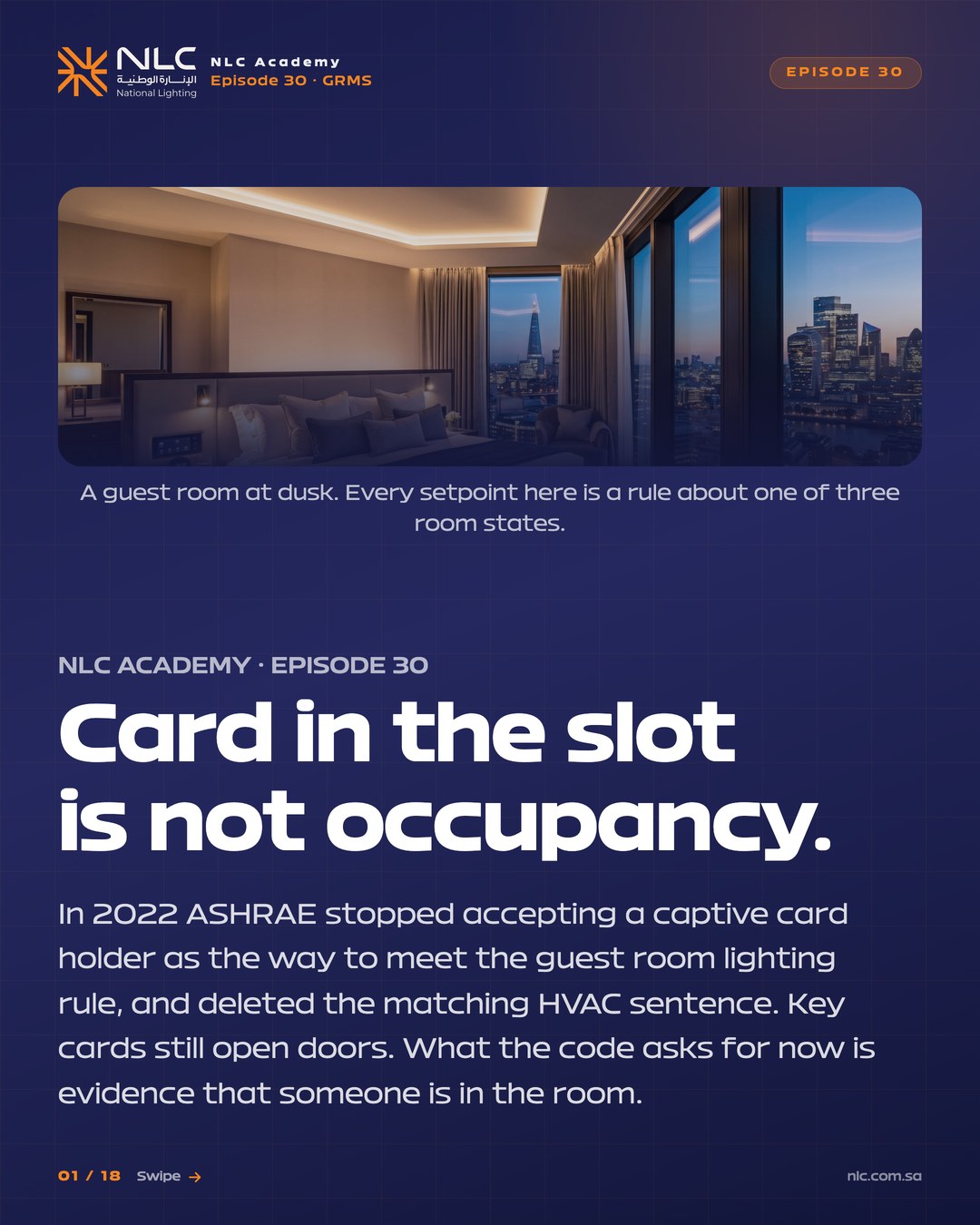
No product standard we could find defines a guest room management system: not in the ISO, IEC, EN, SASO or ASHRAE catalogues we searched. The requirement to control a guest room lives in energy codes instead, and one of them rejects the control method every brochure still leads with: "Card key controls shall not be used to comply with this provision."
Four ideas to carry into the next specification conversation you have.
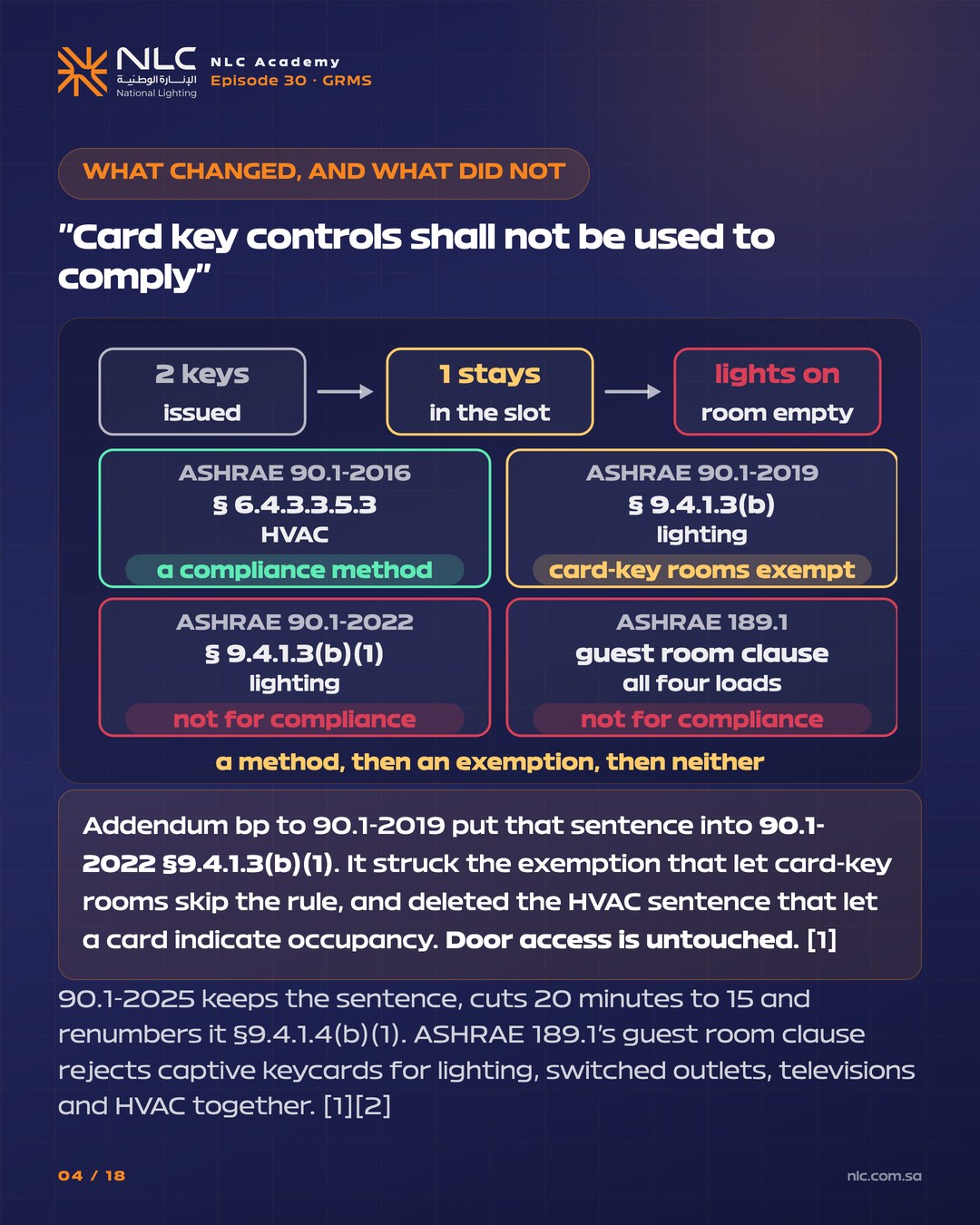
Addendum bp to 90.1-2019 wrote "card key controls shall not be used to comply with this provision" into ASHRAE 90.1-2022 Section 9.4.1.3(b)(1), struck the exemption that let card-key rooms skip the rule, and deleted the HVAC sentence that let a card indicate occupancy. 90.1-2025 keeps the sentence and cuts the delay to 15 minutes. Key cards still open doors; what changed is what counts as proof that someone is in the room.
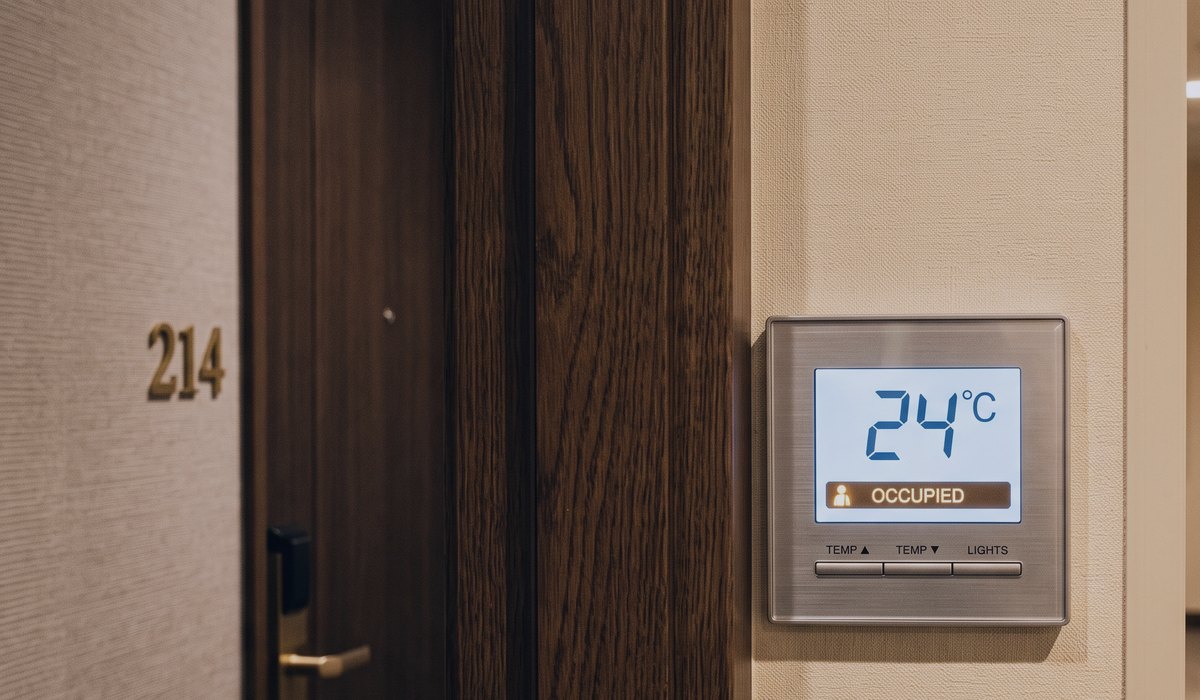
One widely used fan-coil controller's lodging sequence reads the room rather than a card: motion sets occupied and holds it, a door opening and closing drops the room to standby, and anyone still inside must move to bring occupied back. That is also its weakness, so specify the door lock event, the door contact and presence detection in combination, with the standby and unoccupied timers stated in minutes.
Both are deadlines, not waiting times. A controller that cannot see rented status must reach the unrented setpoint of 80 °F (26.7 °C) within 16 hours; one told the room is unrented must get there within 20 minutes, and nothing stops it acting sooner. The code also permits a return to occupied 60 minutes before a scheduled arrival, but Oracle's FIAS specification (release 2.20.25) states that OPERA does not support the scheduler that sequence needs.
ABB's RM/S 2.1 manual is explicit: the controller takes its power from the bus, and card-in lighting runs on internal links with no telegrams. Lose the PMS link, the integration PC, the network or a line coupler and the room keeps working; lose the line power supply or that room's bus cable and it does not. Relay fallback on bus failure is a parameter, not a given, and that is one product in one topology.
ASHRAE 90.1 Section 6.4.3.3.5 for HVAC and Section 9.4.1.3(b) for lighting, with the edition each number comes from. The standard sets behaviour and deadlines and contains no savings percentage.
| Requirement | Value | What it means |
|---|---|---|
| HVAC clause applies | above 50 guest rooms | The lighting clause has no room count; a smaller hotel still falls under the rest of 90.1 |
| Occupied | guest setpoint | No delay and no drift. The state the other two are measured against |
| Rented, unoccupied | 4 °F (2.2 °C) within 20 min | A shallow drift on purpose: the guest is coming back and the room has to recover |
| Unrented, unoccupied | 80 °F (26.7 °C) cooling | Or 60 °F (15.6 °C) heating. Same room, a deep reset |
| Unrented setback due | within 16 h, or 20 min | 16 hours without a rented-status feed, 20 minutes with one. Deadlines, not waits |
| Pre-arrival return | 60 min | Permitted before a scheduled occupancy; a named integration on OPERA, not a checkbox |
| Ventilation off | 20 min | Its own clock. A daily 60-minute purge during unrented periods is permitted, not required |
| Lighting shutoff | 20 → 15 min | 20 minutes in 90.1-2022; Addendum bd, carried into 90.1-2025, says 15 and renumbers it 9.4.1.4(b)(1) |
| Card key for lighting | not for compliance | "Card key controls shall not be used to comply with this provision" |
| Card key for HVAC | sentence deleted | 90.1-2016 let it comply, 90.1-2019 let it indicate occupancy, and Addendum bp to 90.1-2019 struck the clause |
| Saudi classification | 26 to 27 °C unoccupied | Ministry of Tourism criteria v03 (Nov 2024), criterion 189: 20 to 22 °C occupied, guest-controlled AC in every category |
Where the saving comes from, what it is measured against, and what the Saudi numbers do and do not show.
In a metered field study with occupancy logging, rooms were sold on 77 to 79% of days but someone was in the room only 56 to 57% of the time, which left about 44% of room-hours a control could act on. That is an opportunity window in that hotel, not a savings percentage. The same technology gave 27 to 32% HVAC savings at one property and 1 to 17% at an extended-stay property with higher occupancy, and depth of setback moved the number more than the sensor did: on/off control measured 20 to 32%, a 2 °F offset 1 to 6%.
In US lodging, cooling is 12% of building electricity and all HVAC is 44% (CBECS 2018), so a 30% HVAC saving is 13.2% of total building electricity and a 30% cooling saving is 3.6%. "Up to 45%" is usually runtime rather than kilowatt-hours; one manufacturer is careful about it on its own page, quoting 45% runtime and 18% on the bill. In the field evaluation behind these figures savings fell to zero below a 20 °C daily average outdoor temperature, and in the hot California climate zones retrofit numbers ran about 3 times new-build ones because the retrofit baseline had no setback at all.
GASTAT reports hotel room occupancy of 63.0% in Q1 2025, then 53.2%, 49.1% and 57.3% through the year, and 60.8% in Q1 2026, the latest quarter published (a Q2 2026 bulletin could not be found on 2026-10-07). That is rooms sold, not people in rooms: it says how often a control has something to act on, and proves no saving by itself. Payback follows kilowatt-hours rather than percentages: one US field study measured a real 25% cooling saving and still calculated a 27-year payback at $426 a room.
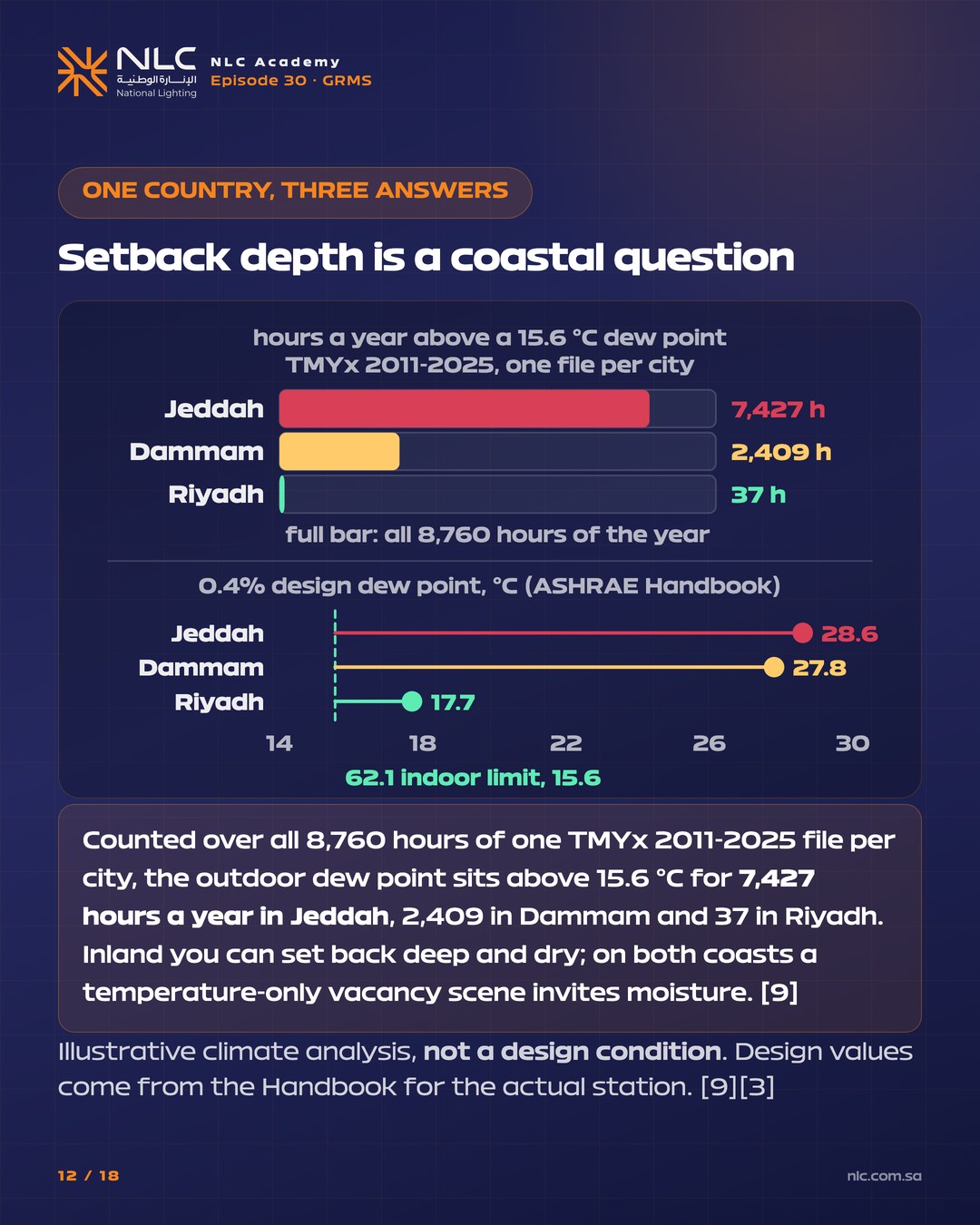
An unrented room at 26.7 °C is not a mould problem on its own: growth needs moisture at a surface as well. Subject to the applicable edition's exceptions, ASHRAE 62.1 sets an indoor dew-point limit during occupied and unoccupied hours, 60 °F (15.6 °C) as written in Addendum ae to 62.1-2016, which binds whenever the outdoor dew point is above that value and carries exceptions of its own, including overnight vacancies under 12 hours held below 65% relative humidity. Addendum bk to 90.1-2019 then permits dehumidification to keep running while the room is empty. Counted over all 8,760 hours of one TMYx 2011-2025 file per city, the outdoor dew point sits above that limit for 7,427 hours a year in Jeddah, 2,409 in Dammam and 37 in Riyadh. Those hours are illustrative climate analysis, not a design condition: design values come from the ASHRAE Handbook for the actual station.
The Ministry of Tourism's current hotel classification criteria (v03, modified November 2024) make in-room air conditioning that the guest controls mandatory in every category and write the setback down: 20 to 22 °C occupied, 26 to 27 °C unoccupied, which contains ASHRAE's unrented 26.7 °C. The same criteria set 100 lux for general room lighting, 250 lux at the headboard from two stars, and a central light switch at the bed from four. These are licensing criteria, not an energy code: the energy code is SBC 601, whose freely readable 2007 edition asks only for a master switch at the entry door, while the current 2024 edition is licensed and was not read for this episode.
We name the three states with their setpoints and delays, require door, contact and presence evidence rather than a card holder, specify unrented status from the PMS within 20 minutes and name the ready-room sequence as an integration with its licence, set dehumidification during vacancy by city, keep access control and life safety out of scope, and put the spares and electronics warranty in the tender.
Practical lighting know-how from NLC Academy. No spam, unsubscribe anytime.
By subscribing you agree to receive NLC emails.
The standards, evaluations and statistics behind every number on this page.
An 18-slide explainer, ready to post straight to LinkedIn as an image carousel.